Empress of the Blazing-World
The Blazing WorldThe Empress of the Blazing-World is a young woman carried by a storm into another world after a merchant abducts her from her homeland. There she becomes the Emperor’s wife and receives absolute authority to govern. Her reign makes her both a creator of political and religious order and, later, the commander of a campaign that subordinates other nations to her native country. The contrast between the peaceful society she values and the coercion she employs gives her sovereignty its central tension.
Identity and Rise to Power
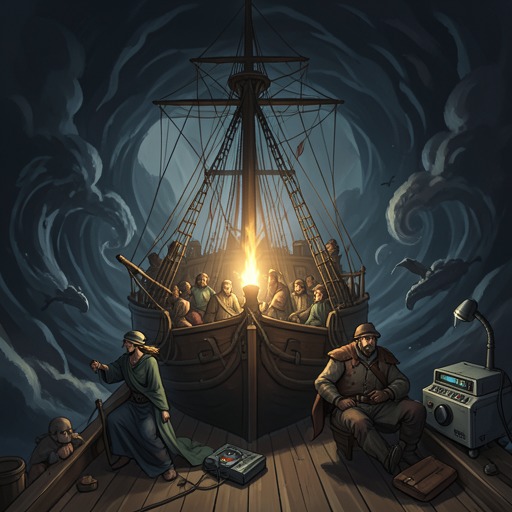
A merchant traveling abroad becomes enamored of the young woman, whose birth and wealth place her beyond his reach. He takes her from the shore in a small vessel, but a tempest drives the boat toward the North Pole and into the Icy Sea. The other sailors freeze during the passage between worlds; she alone survives. The journey begins her transformation from a person acted upon by others into a ruler with power over an entire world.
When the young woman is brought before the Emperor, he takes her for a goddess and offers to worship her. She tells him that, though she comes from another world, she is mortal. The Emperor rejoices at this answer, marries her, and gives her absolute power to govern as she pleases. Her subjects nevertheless continue to regard her with a degree of veneration usually reserved for a deity. Her accession thus rests both on the Emperor’s grant of authority and on a public perception that magnifies her status beyond the mortal identity she asserts.
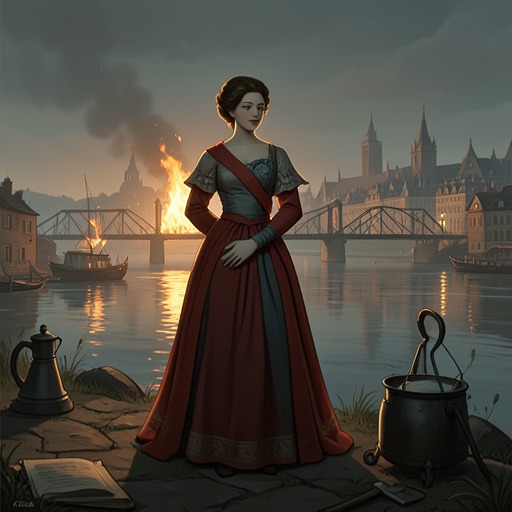
Her imperial appearance makes rule visible through its emblems. She wears a crown and garments of precious stones, carries a rainbow-colored shield signifying the defense of her dominions, and bears a spear shaped like a blazing star to signify readiness against enemies. In the society she governs, the use of gold and jewels is restricted to the imperial family, although precious stones are abundant and trade proceeds by exchange rather than coin. These details set her individual magnificence within a deliberately regulated political order.
Government, Learning, and Religion
The Empress investigates the institutions she inherits rather than governing by spectacle alone. She asks why the state has few laws and why it prefers monarchy. Its statesmen defend limited legislation as a safeguard against division and faction, and single rule as the natural counterpart to one head governing one body. They also connect one Emperor to their worship of one God. The Empress’s inquiries establish her as a ruler who seeks explanations for custom, even when the answers reveal how strongly the polity links political unity to religious unity.
She also encourages specialized learning among the different peoples of the world. Bear-men serve as experimental philosophers, Bird-men as astronomers, Fly-men, Worm-men, and Fish-men as natural philosophers, and Ape-men as chymists; other groups take up medicine, politics, mathematics, architecture, oratory, and logic. She establishes schools and learned societies to support these pursuits. Her patronage treats intellectual work as a public resource, organized according to the varied capacities and professions of her subjects.
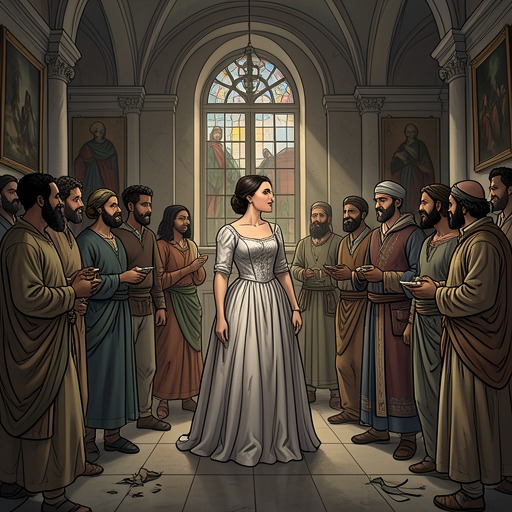
The Empress’s questioning extends to religious arrangements that exclude women from public worship. Priests explain that women pray at home because mixed congregations, in their view, distract men; they also say that women can influence public affairs indirectly through husbands and parents. The Empress then seeks to convert the population to her own religion. She builds churches, establishes a congregation for women, and leads their instruction herself. The women become devoted, and the campaign wins her unusual affection among her subjects. Her religious leadership challenges their exclusion of women from congregational life, while her effort to secure a common faith also reinforces the uniformity on which the polity prides itself.
World-Making and Friendship
The Empress’s power is not confined to the public institutions of her realm. After the Duchess of Newcastle’s soul is summoned to act as a spiritual scribe, the two women form a close intellectual and imaginative partnership. The Empress seeks the Duchess’s counsel on composing a Cabbala, and later invites her to share an imagined world. When the Empress is moved by the Duchess’s creation, the Duchess advises her to make a world of her own rather than merely inhabit another person’s.
The Empress follows that advice. She creates an imaginary world of her own, furnishing it with creatures, laws, arts, and sciences. Its order contrasts with the divisions and conflicts she observes beyond it. She also longs to visit the Duchess’s homeland, despite the Duchess’s warning that it is troubled by factions, divisions, and wars. The Empress arranges for a spirit to occupy her body while her soul travels with the Duchess’s; the episode makes their friendship a shared passage between worlds as well as a collaboration in thought.
The book’s framing presents the Empress’s world-making alongside the author’s own. The Duchess of Newcastle describes the work as connected to her philosophical observations, but also as imaginative writing offered to noble women. In the epilogue, the author distinguishes the peaceful Blazing-World from worlds of conflict she could have invented, and describes the Empress as her dear Platonic friend. The Empress therefore occupies two related roles: sovereign of the fictional realm and a figure through whom the work explores imaginative creation and female intellectual companionship.
Aid to the Homeland and Imperial Expansion
When the Empress reaches the Duchess’s homeland, she learns that her own native country faces attack. She sends a letter to its commanders offering assistance, then explains that she has come from another world to help her countrymen, without bargaining for personal advantage. She says that she is willing to leave behind her tranquility, riches, and pleasure to protect them, and promises to destroy their enemies. Her stated purpose is the safety and strength of her native country, to which she remains loyal despite her status as Empress elsewhere.
Her arrival is staged as a display of power. At night, Fire-stones carried by Bird-men and Fish-men make the air and sea appear aflame; at daybreak, the Blazing-World golden ships, painted dark and stripped of visible sails and weapons, seem to move without assistance. The spectacle confuses and frightens the opposing fleet. The Empress then appears above the water, supported by Fish-men, and addresses the commanders from a distance. Her countrymen thank her, but interpret her appearance in conflicting ways: some take her for an angel or goddess, others for a sorceress or a devil in the form of a beautiful woman.
The Empress’s rescue becomes a project of political subjection. She destroys the hostile fleets and offers the ruler of her native country further aid, proposing that maritime nations pay him tribute. When neighboring states refuse, she orders their ships destroyed until they submit. The resulting tribute makes the King of Esfi master of the seas and, through the importance of maritime commerce, the dominant ruler in that world. Nations that later unite against him are defeated again at sea; the states that can do without foreign trade, or rely on land trade, resist the demand for tribute and face threats of attacks on their towns and cities.
At a later audience with princes and monarchs, the Empress justifies the King of Esfi’s ascendancy as a reward for injuries he suffered and calls on the assembled rulers to pay tribute so they may live peacefully. The language of peace and lawful right accompanies a system maintained by the threat and use of military force. Her campaign begins as aid to a threatened homeland, but ends by extending that homeland’s power across the world. This reversal places the limits of her ideal of peaceful rule in view: within the Blazing-World she prizes unity and tranquility, while beyond it she makes obedience the condition of peace.